Saturday, March 31, 2012

Pinterest is becoming a social network site for sharing interesting images you find online. Hear is some of the links for Marketers SEO optimization.  Interesting thing is Fifty-nine percent of its “pinners” are women between 25 and 40 years of age. Women also make up 58% of its unique visitors.

It states 9 reasons why marketers should use Pinterest
  1. Shift in consumer behavior from search to discovery
  2. Connect with the visual segment of your audience
  3. Inspires the shy content creator
  4. Amplifies the content of original creators
  5. Repinning is the new “retweet” –
  6. Tap into niches
  7. Build your expertise
  8. It’s beating out Facebook referrals
  9. Little interaction needed for brands
MARKETING GUIDE for pininterest.

These links have much more information  about pininterest: stratgies, seo optimization, increasing follower base, tools and other great things. Should read....

http://www.quicksprout.com/2012/02/06/the-marketers-guide-to-pinterest/
http://blog.kissmetrics.com/pinterest-marketing-tips/

Metrics Table for Social Media Marketing


As marketers we are often under pressure to justify budgets, expenditure and resources.  Social media marketing lends itself more to metrics than many other forms of promotional tools. I found the following table from an MIT Sloan Management Review article really useful, it even includes some metrics for brand awareness! Might also help with our assignments,

I hope it is legible and font isn’t too small, taken from a pdf,  :


Hoffman, D.L and Fodor, M (2010), MITSloan, Can You Measure the ROI of Your Social Media Marketing? Fall 2010, Vol 52, No 1

Friday, March 30, 2012

Living Alone: Are you aware of this social change as marketers?

TIME magazine recently featured a collection of articles with the umbrella title 10 Ideas That Are Changing Your Life.  The first one entitled Living Alone is the New Norm states that “The extraordinary rise of solitary living is the biggest social change that we’ve neglected to identify, let alone examine.”

Based on 2011 U.S. census data, this trend was noted among 28% of all U.S. households, a steady shift upward from the 9% registered back in 1950.  This figure now matches and shares the lead with households of childless couples, thus forming a 56% majority.  The nuclear family, multigenerational family, and the roommate/group home categories have taken a backseat.  Despite modern mixed media focus on soccer moms/mommy groups, blended families or roommates with kid in tow, marketers should think about any potential impact of this growing societal shift on how they sell the story of their products and services.
 
Among international single dwellers, the dominant gender is female, and in the U.S., the majority is aged 35-64.  People aged 18-34 form the fastest growing segment living on their own.  The country with the most single dwellers is Sweden at 47% of households, followed by the UK and Japan at about one-third; these contrast strongly with the 3% in India.

This data raises questions such as:  Is this a target segment for your company?  If so, does your Internet marketing strategy need to be adapted to reach them as well as couples without children?  Do your products or services need to be tailored to their needs, something as simple as repackaging/resizing?  Do these subgroups have more disposable income or time for social networking sites and niche consumer interests?  No doubt you'll have more questions.

As we ponder the implications of this social change, no doubt U.S. store chain Target is or will be soon (surreptitiously) on the singleton trail.

(Note:  Subscription required currently to see the full article.)

Thursday, March 29, 2012

Marketing Your Business Properly on a Mobile Website

An interesting article supports the well known findings that the world is increasingly reaching the web through smart phones. Is your business prepared to get the most out of the consumers mobile use?


"Only 10 percent of websites are optimized to be used for mobile platforms," Wittig said. "The first obstacle to overcome for small businesses is to make sure they have a mobile Web page, because everything is going mobile these days and people are typically online with a mobile device." - from an article in the Prague Post.


An important question may be, can my customers navigate well, allowing them to purchase easily? Also is your company losing sales due to the lack of an efficient, comprehensive, smooth operating mobile website? 


Even though the mobile market had a big boom in 2010, it looks like the increase is going to continue.


Also, companies such as Vibes specialize in mobile marketing technology and put together campaigns to increase sales. This may be considered after optimizing the company mobile platform. - from an article in PRNewswire.


The mobile marketing firm Vibes states, "This time next year 5 billion people will own a mobile phone." - from Vibes website. 


Research has shown that the "fastest and largest growing market belonged to smartphones, which are expected to go from 494 million units last year to 660 million in 2012" - from an article in SiliconANGLE.


Please see full article in Prague Post,  SiliconANGLE and PRNewswire.


- David Langone


http://www.praguepost.com/business/12277-smart-phone-growth-prompts-market-shift.html


http://siliconangle.com/blog/2012/03/29/mobile-market-boom-leads-to-increasing-cyber-threats/


http://finance.yahoo.com/news/vibes-vienna-beef-cook-successful-133000039.html


http://www.vibes.com/

Wednesday, March 28, 2012

http://www.youtube.com/watch?v=3IimcIc4_Lo
http://www.luxurydaily.com/rolex-signs-tiger-woods-former-face-of-tag-hueur-as-brand-ambassador/

Tiger Woods lost all of his major sponsorships in the mist of his extramarital affairs incident not long ago (only NIKE stood by him), and one of the companies that dropped him as brand ambassador was Tag Heuer, his wrist watch sponsor.  Tag Heuer thought at the time that Tiger would not be a good representative for the brand.  Months later, Tiger joined team Rolex along with other top athletes in their perspective sports, such as Phil Mickelson, Roger Federer, Li Na and Caroline Wozniacki.

A quote from the article interested me:

“There is always a loss of control when you tie a corporate brand to the behavior of a celebrity,” said Samantha Ettus, a branding expert at Experts Media, Los Angeles. “[But] Rolex made a great decision,
“They are a brand that aims to connote luxury and an expensive lifestyle,” she said.  “Their brand is not tied to anything wholesome or family-oriented.
 I agree with the quote as people associates brands with what the brands stand for, and not relate morals or negativity with the brands. Foe example, when people think of Bud-light, they think of their slogan, "Here We Go" have a good time; people never relate to the underage drinking, bad decisions that comes from drinking or the potential drunk driving that associates with drinking and having a good time.  I think when Tiger had his issues, all of the sponsors became over-sensitive and only NIKE was brave enough to ride out the storm.

Intranet: connecting employees, making things easier and innovating

Last week we discussed about "using social media to engage and motivate employees" and besides McDonald's social media program, IBM and Zappos incentive for their employees to be connected, we did not mention some companies which have been working with intranet as a daily tool between the staff.

Not only for social communication and human relations, but meanly to provide different kinds of information access for everyone who works for the company.

Employee engagement and motivation as mentioned in the textbook are some of the important results reachable by the social channel. What's been noticed by the own employees? That information access can be faster through the intranet. Information about the company, about other employees, and data.

Nilsen Norman Group has been rewarding companies' intranet and selling the report:


This page showcases the winners and links to case studies.

Staples' intranet, "The Hub", for example, was recognized by Nielsen group because of its accomplishments. Since 2006, the website provide a easy communication channel between 26 countries which is the best way for them to talk with stores associates. Moreover, people can check the company policies and procedures, learn from videos and be aware of results.


http://www.useit.com/alertbox/intranet_design.html

http://www.nngroup.com/reports/intranet/design/awards.html

Dropbox Hack Week at New Offices

An article came out recently which demonstrates an example of great, inexpensive, and effective use of social media and public relations for a fast-moving internet company.  Dropbox is one of the industry's fastest rising companies in recent years, and it recently received a $4B valuation based on recent investments in the company. The company's founder Drew Houston has been featured on the covers of major magazines ranging from Forbes to Technology News, and he has shown great skill in using media like interviews and news pieces to generate publicity for his company.

TechCrunch recently ran an article covering Dropbox's "hack week", in which its employees were allowed to spend one week developing software projects they were interested in and to unleash their creativity.  Houston also invited a film-maker to cover hack week and create a video about it.  All of this was featured on TechCrunch as news, and the article also raised awareness over the company, its brand new expanded San Francisco offices, as well as its redesigned product offerings. This coverage was further magnified through online news and social networks. In fact, I found out about this from various shares and likes of my Facebook friends.

Probably more important than all of the publicity and increased awareness for Dropbox about its new location and products, was its potential impact for future recruiting of talent, and for positioning Dropbox as the next great, hot place to be for the best programmers.  Dropbox demonstrates a great understanding of what drives, motivates, and pleases their best workers, and their hacker culture and the brand that they are trying to create within the industry will help it continue to recruit or retain the best and brightest. The video covering their "hack week" also showed all the amenities current employees enjoy, such as catered food, skateboarding, ping pong tables, arcade games, and fun work spaces.

It was a very clever, inexpensive use of an event, media coverage, and expanded shares through social media to further strengthen its brand, build good will among its customers, as well as increase workplace satisfaction among current and prospective employees.

The future of technology and marketing

The IMedia article from author Jennifer Marlo, make us consider the vision of the future that the marketing give us and the real future. While the technology scientists are trying to develop a more human like, personalized and entertaining technology the marketing media take us to a less human vision.
The article exemplifies the issue with a simple picture;  if analyzed like a futurist can strike the senses but empty the spirit or let say that future in the picture looks less cozy and very empty; is that dishonest marketing? mmm maybe or maybe it's to much analysis for a simple picture or maybe the marketers are showing the wrong vision about future and technology.  I suppose at the end is all about perceptions.
For the complete article go to The future of technology and marketing
Enjoy.

Online Retail Revolution hits India

An interesting Reuters article points out how Internet based retail, which is taken for granted in the first world countries, is revolutionizing the retail business in India. In fact, for many (rich and poor alike) this is the first time they get access to various categories of goods.

According to a  Boston Consulting Group study, online retail in India could be a $84-billion industry by 2016 -- more than ten times its worth in 2010 -- and will account for 4.5 percent of total retail. And most of this business will not come from large cities...it will come from small-town India.

A number of new and dynamic startups are at the helm of this fast paced change - flipkart.com, Indiaplaza.com, makemytrip.com (also listed on NASDAQ) and many more. However, the article claims that the real change started with the Govt website selling railway tickets online - irctc.com. This brought about an attitudinal change for the janta and has made the whole concept of buying things online more acceptable. 

Tuesday, March 27, 2012

Internet marketing strategy decision advice needed

Here is an opportunity for some of my classmates/colleagues to apply their IMS learning to an actual decision that my corporation needs to make. In exchange, I get the benefit of objective input from well-educated but unbiased third parties. I own a law firm, DeLuca & Associates. It is one of the highest volume consumer bankruptcy firms in the country. We have about a million dollar annual advertising budget including television and a heavy internet presence. We were discussing adding a “book your own appointment calendar” that integrates directly with a live Outlook calendar. Thereby, new clients can book their own appointments directly on the website with a continually updating calendar system that is simultaneously being used by staff to book consultations made via telephone. The concern is not so much the $25K price tag to build this functionality into the website and link it to a live calendar, but whether we would lose initial consultations by not having the human interaction. Many new clients are set up for consultations because they speak to knowledgeable staff members that alleviate their fears about the bankruptcy process and answer some basic questions. My concern is that potential new clients may not be as inclined to feel accountable for keeping their appointment when they book the appointment online as opposed to speaking with an employee. Second, we lose the additional opportunity via telephone to reiterate the value of our services and our ability to competently represent them. The upside is that it cuts down on client interactions and employee time spent on the phones. In turn, employee resources may be used in other areas. Second, it provides the potential client an additional avenue to get into our office for an appointmnt. Third, many people like the efficiency of booking the appointment right there and then instead of having to make an additional phone call. Finally, some potential clients feel uncomfortable about talking to anyone about filing for bankruptcy and the internet calendaring option provides additional privacy and comfort. The basic question is whether my firm will likely lose consultations by not having the human interaction, or will individuals be just as likely to make the appointment and keep it via online appointment calendar. Any thoughts, opinions, ideas, or suggestions are welcome. Thank you for any input. I've been going back and forth on this one for two weeks now.

Are You Identifying with The Headline of This Chart?


Marketing Sherpa's Chart of the Week from today's email. Often these charts come directly from paid reports and can't be accessed on the website.

Objectives and ROI

This post has some of the SMM myths I didn't include in last week's lecture. More important, it stresses both the importance of ROI and the complexity of measuring it in a SMM setting. ROI can't be demonstrated without good objectives and metrics to measure them in any context.

This post ties together SMM from last week and lead generation/management this week. A worthwhile read; it also has some useful metrics listed.

Monday, March 26, 2012

What is your Twitter Account worth?

Last week's Social Media Marketing class set me thinking - What is your Twitter Account worth? Recently there were news reports of company's suing former employees for 'recovering' (money, the twitter handle etc.) what the company had 'lost' when the employee left the company. In the class we talked about getting  'personal ' on Facebook and/or Twitter. So instead of using a cold sounding company 'handle', a more personal 'handle' with possibly your own name gives a much personal touch. It makes the customer feel connected with the company they are interacting with. But what happens when the employee leaves? Who 'owns' that handle? More importantly, how much is it worth to the company? If he/she had 1000 followers for the 'handle', how much would someone pay for it? How would you price it? No easy answers! It is indeed a very interesting world with Social Media Marketing and lines between personal and business will increasingly blur.

This Mashable article gives an example of a company suing a former employee for his Twitter account -

http://mashable.com/2011/12/26/twitter-court-followers/

From the article:
"Noah Kravitz left his former employer PhoneDog in October 2010 on good terms. Now the company is suing him for $340,000 for the 17,000 followers he kept after he left the the position, valuing each follower at $2.50 per month over a period of eight months."


Making the wrong friends using social media marketing


After the last lecture I became very interested in social media marketing, however this article describes my biggest concern about it: “3brands that made the wrong friends”.
Social media marketing requires a lot of planning and as the article’s author described, there are four ways to avoid damage from bad fans:
-Do a reality check;
-Think about how your actions and programs might be interpreted;
-Consider whether you can turn bad fans into business opportunity;
-Grow thick skin

I agree that the reality is that you can’t control every aspect or result of social media marketing, and once engaged you should expect a few hits along the way. The difference is how you respond to these situations and what lesson is to be learned through this experience.

Sunday, March 25, 2012

Google Panda:3 simple ways to achieve"fresh" content?

http://www.entrepreneur.com/article/222651

How do you optimize your website to get picked up by search engines after Google Panda?

The basic idea is to update content on regular basis so it is considered "fresh," and make sure information posted is "timely" and of good "quality"

One marketing consultant suggests three "simple" ways:
1- Set schedule to make sure you publish something on your website on regular basis
2- Develop content on items in the news so Google identifies it as "fresh" content
3- Be the first to write about industry relevant news so information published is timely and of good quality.

Well not so simple if you try to apply it.
If I post a monthly newsletter on company website strictly about company products with nothing related to any items covered in the news or related industry, will my monthly newsletter qualify as "fresh" "quality" or "timely" content? 

How can Google Panda decide?  I honestly get it as much as I get why Google called it Google Panda!


Saturday, March 24, 2012

From the Wonderful World of Facebook

First an email from my website host.

They want to do a customized Facebook page for me, and they are good at offering incentives to get a customer to purchase.

Ok, they are offering 50% off. So far so good. First month? What are they going to do after they create it?

If you could read the second paragraph, basically it says they are going to maintain it. Ok, where do they get the relevant content???

And I'm sure you can't read the small print at the bottom. It implies that the charge is $40 per month after the first month.

Does this make good marketing sense?


Facebook is now offering "log out" ads; not an entirely new concept; some of the 'ride along' ads that are so annoying are only seen after you leave the page. But it's new for Facebook, and they'll be happy to sell you an entire day's worth for about $700,000!
a) Do you like the idea of the format?
b) Do you log out? Do you think most people do?
Read the entire article on Ad Age before it goes subscription only 

Google will institute a ranking penalty for sites that are overly optimized.

Refer to the article - Google Previews a change to natural search - http://www.internetretailer.com/2012/03/22/google-previews-upcoming-change-natural-search-rankings


As we know that how SEO is important to rank a particular webpage tops in the organic search results, however, Google is making changes to natural search within the next few weeks or months by penalising sites that are overly optimised. 

Though this new proposal is to reward websites that offer good content and positive user experience, companies who need to rank tops by adopting keyword stuffing or black hat link building will most likely suffer. New websites that need to quickly rank tops in the organic result would adopting such illegitimate methods. In a highly competitive market, making one searchable is very critical to a business when most of the customers would first search in a search engine before buying a product or service.

Wednesday, March 21, 2012

Facebook Deploys Salesforce.com's Rypple Throughout the Enterprise

I think this has major implications on the HR industry and it doesn't hurt that the largest social network in the world has adopted your platform. Salesforce's new tool Rypple is an internal social performance management tool that brings the enterprise together. Could this be another blow to enterprise email? How do those of you in the HR world feel about their encroachment into providing HR solutions? Do you see this as a threat?

http://www.youtube.com/watch?v=5RaRrqSkiM0

Mailchimp, twitter, social media puff, yes all together

This article published by Marketing Vox, talks about the new strategy the MailChimp is pushing to integrate more with social media. "For example, the MailChimp blog post notes that it shows who subscribers generally follow and what kind of other companies the subscribers follow." This article can be an example for Chapter 9  in the area Developing a Social Media Marketing Strategy, where the email is used for listening the target audience and communicating with your audience in social space. Now the marketers  can see what the people in the mail lists like and develop contend and strategies based on the trends that their audience is attracted to and make it work better for  the company if that is possible.


Can we visualize any privacy problem?  To check the article go to: 


MailChimp's Tweet Trends Part of Email Marketing's Social Media Push 


Community????

While reading Chapter 9 I stumbled in a subject that always got me a little confused, the concept of Social Media and the concept of Community. Let's start with the simplified definition of community that the author presented us with:


"..when a group of people, of their own volition, began to congregate around one or more platforms that deal with subjects of interest to them. The interests can be very broad, such as sports or entertainment news. They can be niche, such as a blog about golf or a site that answers income tax questions. Sites that attract even a small number of regular users can be referred to as a community." pg.239


People sometimes use Social Media and Community interchangeable but they are definitely not the same thing. In certain occasions I've heard people saying that they posted a review of a book on Amazon's Community, what is wrong. That may sound to us Marketing students a little silly, but that normally come from our target audience. Users (costumers, members, partners), are confused with all the new terms that Social Media had been trowing at them and sometimes they have no idea, what "WE" are talking about. In the case of "Community", I did a little research and found this short list that may help.


"Communities have the following characteristics:
- They are continuous, not temporal - this is not to say that people don't drop in and out but there is a core membership that interacts together over a long period of time.
- Communities gather around a concept or common goal not around a collection of content (although content does plays a major role, it is not the impetus for the community).
- Communities take on various conversations and activities, led by different members over time - it is not one conversation but many.
- People within communities get to know each other and interact regularly without centralized facilitation and not necessarily in the context of what the community is discussing as a whole.
- Community leaders emerge over time as they continue to take proactive roles in the community and rally other members to their causes. These leaders are community members and they self-select because of their interests - not because they are told to do so...although they can be encouraged to do so." 
Extracted from "The Social Organization" http://www.thesocialorganization.com/2008/07/social-media-is-not-community.html

While writing a paper last year about how Social Media had changed the way organizations are run, I found a great example of a successful community that I personally use and take great advantage of it. The one created by Intuit to support their accounting software QuickBooks. While trying to learn QuickBooks many times I went back and forth their support community for tips and information, and most of the time I was impressed with how they put their users to literally "work for them".
Enjoy the article:
How Intuit Makes a Social Network Pay by Reena Jana
http://www.businessweek.com/magazine/content/09_28/b4139066365300.htm

Sunday, March 18, 2012


Let’s do some shopping through a mobile app! Western Europe finally catching up

Recently I have been researching information on mobile internet usage and associated with that shopping through mobile apps within Western Europe with a special emphasis on UK. As a European residing in London, I am very much happy to hear that we are finally catching up with the States in the field of m-commerce. Please find below some key facts and figures on m-commerce for UK and other Western European countries:

  • Mobile Internet access will overtake desktop PC by 2014 reaching 1,800 MM users. This is expected to further grow reaching 2,000 MM Mobile Internet Users vs. 1,700 Desktop Internet Users in 2015 (Morgan Stanley, April 12, 2010) [i]
  • In 2009 online sales accounted for 68EUR billion and are estimated to grow by 11% reaching 114EUR billion in 2014 (Forrester, Western European Online Retail Forecast 2009-214). On average, Western Europeans spent in 2009 approximately €483 per person whereas in 2014 they are expected to increase these amount to €601 per person.
  • The number of UK smartphone users doubled between 2008 and 2010 from 5.5 million in 2008 to 12.8 million in 2010 (At. T. Kearnay Inc., The Internet Economy in the United Kingdom)[ii]. 87% of mobile devices that accounted for Website Traffic in September 2010 were represented by iPhone, iPad, Android and Blackberry (Tecmark Research, February 2011)[iii]
  • Consumers are more willing to finalize their purchases as both basket abandonment and checkout abandonment dropped. Number of consumers who did not check out declined by 5% (1Q 2010) from Q1 reaching 32% in Q2 of 2011 and the basket abandonment rate dropped by 4% reaching 59% at the end of the year. (Capgemini E-ratail Index)[iv]
  • Overall there were 20.76 million mobile commerce users within the UK. Overall, 37% spending are up to 100 GBP vs. 11% are willing to spend up to 1,000 GBP. With 35 million mobile commerce users London has the most potential.
  • Traffic to brand.com website through mobile phones increased by 7% from 2009 reaching 8.09% in 2011.iPhone traffic accounts for more than half of all mobile traffic. (Tecmark Research, February 2011)[v]
  • There were 19.97 million UK mobile internet users in 2010. By the end of 2012 a growth of 33% is expected. This will account for 27.68 million. Number of smartphones in 2010 was equivalent to 59% whereas by 2012 this number is further expected to grow reaching 78% (mobile squared, 2010)[vi]
  • 28% of leisure travelers, who perform travel related-activities via mobile Web, use mobile websites to do so whereas 72% use some a combination of mobile websites and applications. Apple users engage themselves in 5.7 travel-related activities per year whereas Blackberry ones are less engaged and they perform in 4.5 times per year. (New Media Trend Watch, March 2012 [vii]
Have a good day,
Best regards,
Natalia

References:


[i] http://www.morganstanley.com/institutional/techresearch/pdfs/Internet_Trends_041210.pdf, Internet Trends, Morgan Stanley, April 14, 2010, accessed on 12/03/2012
[ii] http://www.atkearney.com/index.php/Publications/the-internet-economy-in-the-united-kingdom.html, The Internet Economy in the United Kingdom, A.T. Kearney, accessed on 12/03/2012
[iii] http://www.tecmark.co.uk/wp-content/uploads/2011/03/Tecmark-Mobile-Internet-research-paper.pdf, Mobile Web Device Trends, Tecmark, February 2011, accessed on 12/03/2012
[iv] http://www.imrg.org/ImrgWebsite/User/Pages/Press%20Releases-IMRG.aspx?pageID=86&parentPageID=85&isHomePage=false&isDetailData=true&itemID=6127&specificPageType=5&pageTemplate=7, Average Percentage of Sales over Mobile Jump from 0.4% to 3.3%, IMRG The Voice of Retail, October 21, 2011, accessed on 12/02/2012
[v] http://www.tecmark.co.uk/wp-content/uploads/2011/03/Tecmark-Mobile-Internet-research-paper.pdf, Mobile Web Device Trends, Tecmark, February 2011, accessed on 12/03/2012
[vi] http://www.mobilesquared.co.uk/pdfs/mobile_market_trends_uk.pdf, Mobile Market Trends: UK, Data to engage with consumers, 2010-2012, accessed on 12/03/2012
[vii] http://www.newmediatrendwatch.com/world-overview/91-online-travel-market?start=1, Online Travel Market, New Media Trend Watch, March 7, 2012, accessed on 12/03/2012

When culture reigns over statistics and technology


Here are a few statistics to consider:

           1.     78% of Internet users conduct product research online.
  1. 78% of business people use their mobile device to check email.
  2. 40% of US smartphone owners compare prices on their mobile device while in-store, shopping for an item.
  3. 91% of email users have unsubscribed from a company email they previously opted-in to.
  4. 84% of 25-34 year-olds have left a favorite website because of intrusive or irrelevant advertising.
  5. 57% of businesses have acquired a customer through their company blog.
  6. 67% of B2B companies and 41% of B2C companies have acquired a customer through Facebook.
  7. The number of marketers who say Facebook is “critical” or “important” to their business has increased 83% in just 2 years.
  8. Companies that blog get 55% more web traffic.

Looking at statistics above, I would say too much of statistics acquired online is relevant to developed countries.
Take statistics on Facebook for instance. Here in Arab world, many managers and business owners still hold the view that Facebook does not provide their company with a professional image- a testimony that culture reigns over statistics and technology.  
Still fewer companies in Arab world have blogs. 
Of course things are changing but at a relatively slower pace. 
I am curious to find a reliable source on statistics for Arab world and would be grateful for feedback!  


Hi Every one.

Currently, I am not in any team for Marketing Plan. Let me know if any one is willing to form a team or accept me into your team. Please Message/Call/Email me to Sreepathi@gmail.com , 908-770-0582

Thank You


Customer Experience

You may find your brand listed in the Tempkin customer experience ratings, just out. Even if your brand, or its parent company is not included, you will find how they rank customer experience to be thought provoking. It's a subject we spend too little time on in this class.

Saturday, March 17, 2012

"The Fancy" vs. Pinterest - Which is Better for Online Marketing?

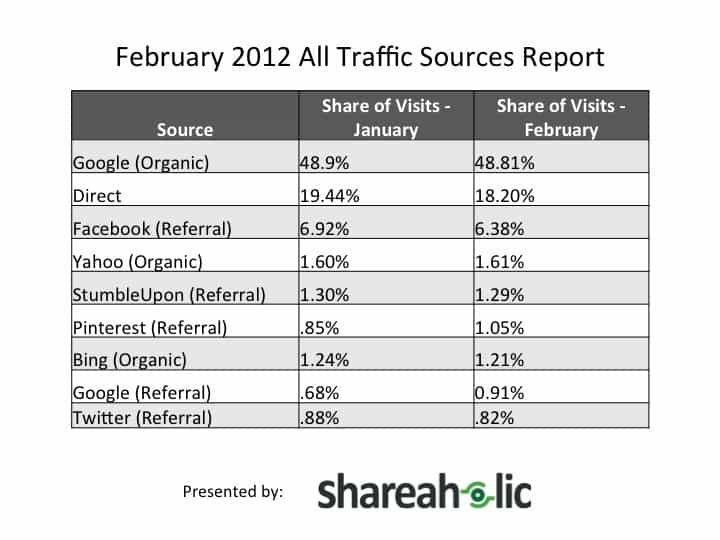
By now many of us have heard of Pinterest.com. If you haven't it's an online pin board that let's you share image content on the web, and it's growing in popularity. This is a great tool, a recent study has shown Pinterest is driving more traffic to websites than Google, LinkedIn, YouTube, and Twitter [See table below].


Well, I recently stumbled upon TheFancy.com. In many respects both sites are similar to one another, except for one major aspect. Although, Pintrest has become hugely popular in the recent months, it currently lacks a  sufficient business model, this is where The Fancy comes in. The Fancy allows users to post images, share those images, as well as allowing users to buy and/or sell those items. For example, with Pinterest you may see an image a user posts of his or her recipe for "Triple Layer Fudgy Mint Oreo Brownies." Looks delicious right? Well wouldn't it be nice to purchase them instead of looking at them?

Triple Layer Fudgy Oreo Mint Brownies


This is where The Fancy picks up where Pinterest leaves off. User's have the ability to browse images that others have shared and do something every marketer loves, make a purchase! Instead of looking at that ultra Mumbai chic hotel in an exotic location, you can actually book it!


Aquaria Grande Tower


I'm sure Pinterest won't be too far behind, but for now the winner is... The Fancy. Given that the business model remains effective, it may have implications on e-commerce sites such as eBay. We'll wait and see.

The Marketability of Celebrities! Will Your Company Benefit These Endorsements?

     Of course people see it multiple times every day. From Tom Brady modeling products such as Ugg Boots on a New York City billboard, to Danika Patrick selling the Go Daddy Service on Television. Obviously some of these campaigns turn out well for the companies, and some not so well. It is a fairly risky marketing approach. On one hand if you contracted with Bode Miller for $4 million dollars, as the company Barilla did, you may lose big. The Olympic skier never won a metal and ended up in the tabloids, viewed as an inebriated player. Although things can go the other way. Someone like Eli Manning can get paid six figures for a Citizen Watch campaign, then go on to win the Super Bowl and help the companies campaign greatly. This works since they contracted him originally at a reasonable price. Companies seem to seek out those celebrities that are successful at their craft, but stay out of personal drama and limelight. This is why certain celebrities are more marketable than others. (Newsday Article Below)
- David Langone

Read the entire article on Newsday here.

Curious about augmented reality?

While researching for the first strategy paper, I came across my target company’s use of augmented reality (AR) in their digital marketing strategy.  I had missed the boat on this technology and felt compelled to learn more about it.  This recent Ad Age article explained AR in a logical sequence of Q&As for today’s digital marketer.  As Professor Roberts has been emphasizing with our Internet marketing plans, this article points out that a brand shouldn’t embrace AR without a clear digital strategy and objectives.  It explains the different types of AR – web-based, kiosk, and mobile – and states that the first two are in a mature phase right now for brand use, whereas mobile AR currently has limitations that aren’t in sync with brand and consumer expectations.  Issues such as a fragmented development environment with different smartphone types, processing power demand, and battery life all support Forrester’s recent report that mobile AR isn’t fully up to speed yet.

Nevertheless, I did find it fascinating to see the varied uses of AR brands have already achieved to generate buzz.  For web-based AR, check out this Tissot watch example.  For kiosk and mobile examples, see the AR video posts for National Geographic and REI (below), plus others, in the Digital Buzz Blog.


Friday, March 16, 2012


Websites must be user friendly! Having a good web page is an important tool of internet marketing. Customer satisfaction must be met online even before purchase or purchase decision is made, not just in person!


http://www.fastcompany.com/1825005/impatient-america-needs-faster-intertubes

How many web sites have you seen with some fancy flash intro that you just couldn't stand?

Web 3.0...already?

Are we staring at the future already...and don't even know about it? A recent Marketing Vox Article talks of how the whole Semantic Search issue is filled with contradictions with Search gurus all split on What, When and How.

Wall Street Journal's article yesterday spoke of how Google is realigning its focus, in a more radical manner, on making the search more Semantic - changing how users will experience their search results and how advertisers can expect their ads to be served up by the engine. Semantic Search would take the emphasis away from keywords and place greater emphasis on scrolling website text (apart from other parameters). Now, this is big news for any marketer...or is it? Isn't this already the case? Can't say...

It seems, from what a lot of experts are saying, that this whole article seems wrongly timed. Google has been at it for a year or so. Recipe View, a filtered search result for recipes, was already on the same lines, it says. Also, read this Archived article from 2010  which exalts the early forays into semantic ad placements.

The other explanation is that Google is now publicly coming out of the closet on this one. That it wasn't really sure earlier about the technology itself till now. No, Web 3.0 hasn't been achieved yet. It's only a matter of time!


Thursday, March 15, 2012

Thinking About Using Facebook in your Marketing Plan?

Then you need to read this article and the two earlier ones it links to. I'll talk a little bit about engagement and other social media metrics next week and again when we cover metrics in ch 14. However, I don't have much time to spend on any one topic, so read and heed!

Facebook ads power

Here is an small article about how much power Facebook ads have. The article shows a small but big example of the massive audience reach of Facebook ads. Facebook reafirms its position to Big and small companies.
Very interesting.
Facebook Continues to Make Its Case to Brands, Both Big and Small

Salesforce CEO Benioff Emphasizes Social Revolution and the Social Enterprise at Cloudforce

Marc Benioff, CEO of Salesforce.com, spoke today at Cloudforce. Specifically, Benioff spoke on how to engage customers, employees, and collaborator with an emphasis on social enterprise. Some of the key points included:

  • The Social Revolution: How Social Media Eats the Web. Approximately 8 hours of usage per month vs. the Remaining Amount of Web Usage. 
  • The Social Revolution: How a New Generation of Devices are Changing the Way we Access the Web.

  • The Social Revolution: How Products are Now Connected to Social Networks.


Salesforce.com also introduced their new product Rypple, stating that the old HR applications were built for HR managers and not for employees. Rypple will be a shift in the paradigm of compliance and politics to real-time performance management and also adds social/mobile gaming aspects, such as badges, comment streams etc...


Images & Information acquired from Salesforce.com's Cloud force event March 15, 2012: https://apps.facebook.com/salesforce-tm/

Wednesday, March 14, 2012

QR code not readable with everyday scanner application

Going back from work, I took a picture just to show you that in Paris like in Boston you can find QR codes, and Flashcode everywhere. 

The following one was not readable with standard scanner application:


The logo of the AT&T application is based on a Flashcode (and not a QR code):


Below the QR code I created for this blog:


Here a QR code for the website:


A QR code I found in Cambridge:


The landing page (result of the scan):